
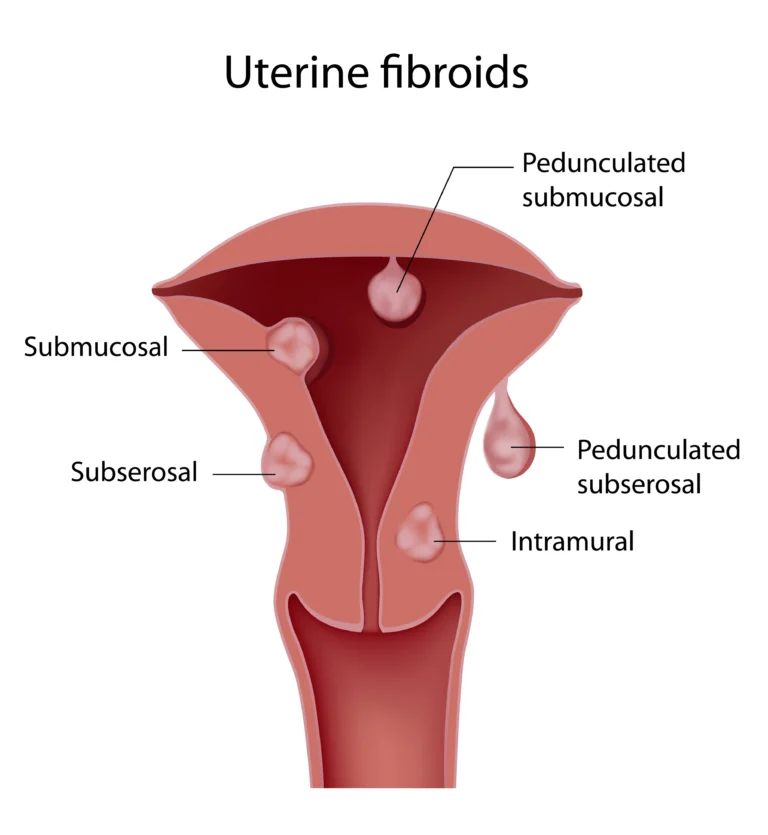
Fibroids
Surgical procedures involving the treatment of Fibroids are:
➔Myomectomy: This procedure removes individual fibroids without disturbing the uterus.
➔Abdominal myomectomy: Involves an incision in the abdomen, typically used for large or numerous fibroids.
➔Laparoscopic myomectomy: Uses small incisions in the abdomen to remove fibroids using a lighted scope and instruments.
➔Hysteroscopic myomectomy: Removes fibroids from inside the uterus through the vagina and cervix.
➔Hysterectomy: Surgical removal of the uterus, which permanently eliminates fibroids but results in the inability to bear children.
Can be performed abdominally, vaginally, or laparoscopically.
Other minimally invasive procedures include:
➔Uterine Fibroid Embolization (UFE): A nonsurgical procedure that blocks the blood supply to the fibroids, causing them to shrink.
A catheter is inserted into a blood vessel, and tiny particles are injected to cut off blood flow.
➔Radiofrequency Ablation: Uses heat from radiofrequency energy to destroy fibroids while leaving healthy tissue intact.
Often performed using a laparoscopic approach with a special probe and handpiece.
➔High-Intensity Focused Ultrasound (HIFU): Uses high-intensity ultrasound waves to heat and destroy fibroid tissue without incisions.
➔Uterine Fibroid Embolization (UFE): A nonsurgical procedure that blocks the blood supply to the fibroids, causing them to shrink. A catheter is inserted into a blood vessel, and tiny particles are injected to cut off blood flow.
➔Radiofrequency Ablation: Uses heat from radiofrequency energy to destroy fibroids while leaving healthy tissue intact. Often performed using a laparoscopic approach with a special probe and handpiece.
➔High-Intensity Focused Ultrasound (HIFU): Uses high-intensity ultrasound waves to heat and destroy fibroid tissue without incisions.
Meet Our Doctor